Uptown Funk AI Trend & Timeline
Last updated:
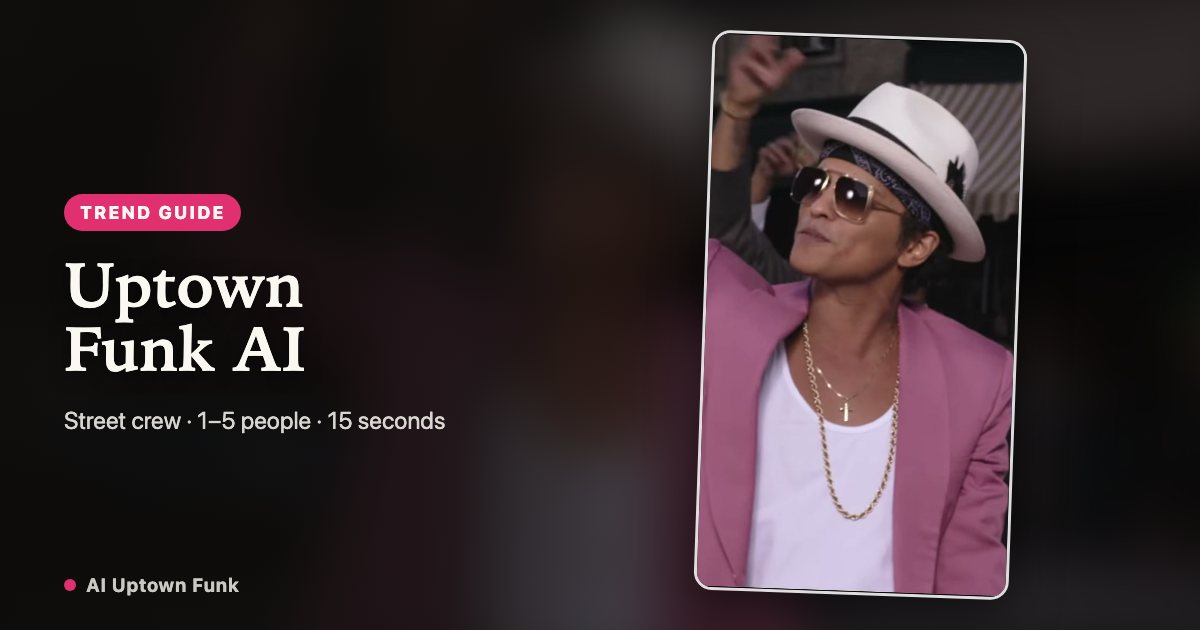
The Uptown Funk AI trend is easy to recognize: a lead in the center of a street lineup, four supporting performers, compact coordinated steps and cuts that return to the lead’s face. The AI version changes who is in the crew.
From the music video to AI remixes
The original 2014 music video established the street setting, coordinated lineup and playful performance style. Later AI remixes reuse that recognizable visual language with a different cast. Reference template pages reviewed in October 2026 describe versions featuring recognizable groups and personal crews. Those pages are examples of the format, not proof of who made the first AI version.
A useful timeline separates the original music-video release, the appearance of AI cast remixes, and the later template tools that let people upload their own portraits. Claims about the first post or exact view counts need primary evidence; this guide does not invent an origin date or audience number.
What the supplied clip actually shows
The supplied reference is a 15-second 1080p landscape clip at roughly 23.976 fps. It shows a five-person street crew, brick storefronts and striped awnings. Wide group movements, low-angle crouches, kicks and closer views of the lead alternate across the clip.
The important visual relationship is the lead and the crew, not a single unbroken camera move. Each cut needs to preserve the identity assigned to a dancer. A portrait that looks clear in the first shot may still drift in a wider or moving view; reviewing the finished clip matters.
What changes in your remix
AI Uptown Funk takes one portrait per replacement. Photo 1 is always the lead. Additional references fill far left, far right, inner left and inner right, in that order. Choosing one person replaces the lead without promising that only one dancer will appear; the reference still contains a crew.
The outfit directions are Keep my look, Retro suits, Football crew and Wizard crew. They describe the requested wardrobe. They do not imply that the reference preview already shows those generated outcomes. No celebrity preset or branded costume is needed to make a recognizable personal crew.
Why reference video and identity photos have different jobs
The video supplies motion, framing and the relationship between shots. The portraits supply identity. Feeding a selfie as a literal first frame is a different workflow: it may reproduce the selfie background instead of placing the person into a street routine. Separate reference materials and explicit role instructions give the model clearer guidance.
The output is 15 seconds at 16:9. The supplied reference is already the requested length, so it is not stretched or slowed down. This is a reference-guided generation, not a promise of identical frames, camera timing or facial detail.
Models, cost and sharing
The smaller cast uses Kling 3.0 Omni: 99 credits, sold for $9.90. The larger cast uses Kling 4.0: 199 credits, sold for $19.90. These are the site’s retail prices, separate from the upstream provider’s processing costs. Failed renders restore the credits spent on that job.
The supplied reference audio is retained. We copy its compressed audio samples into the finished video, replacing any model-generated track without changing pitch, speed or volume. Download the finished MP4, inspect faces and motion, and keep the AI-generated disclosure when sharing it.
Your crew. The Uptown Funk routine.
Create my crew video